
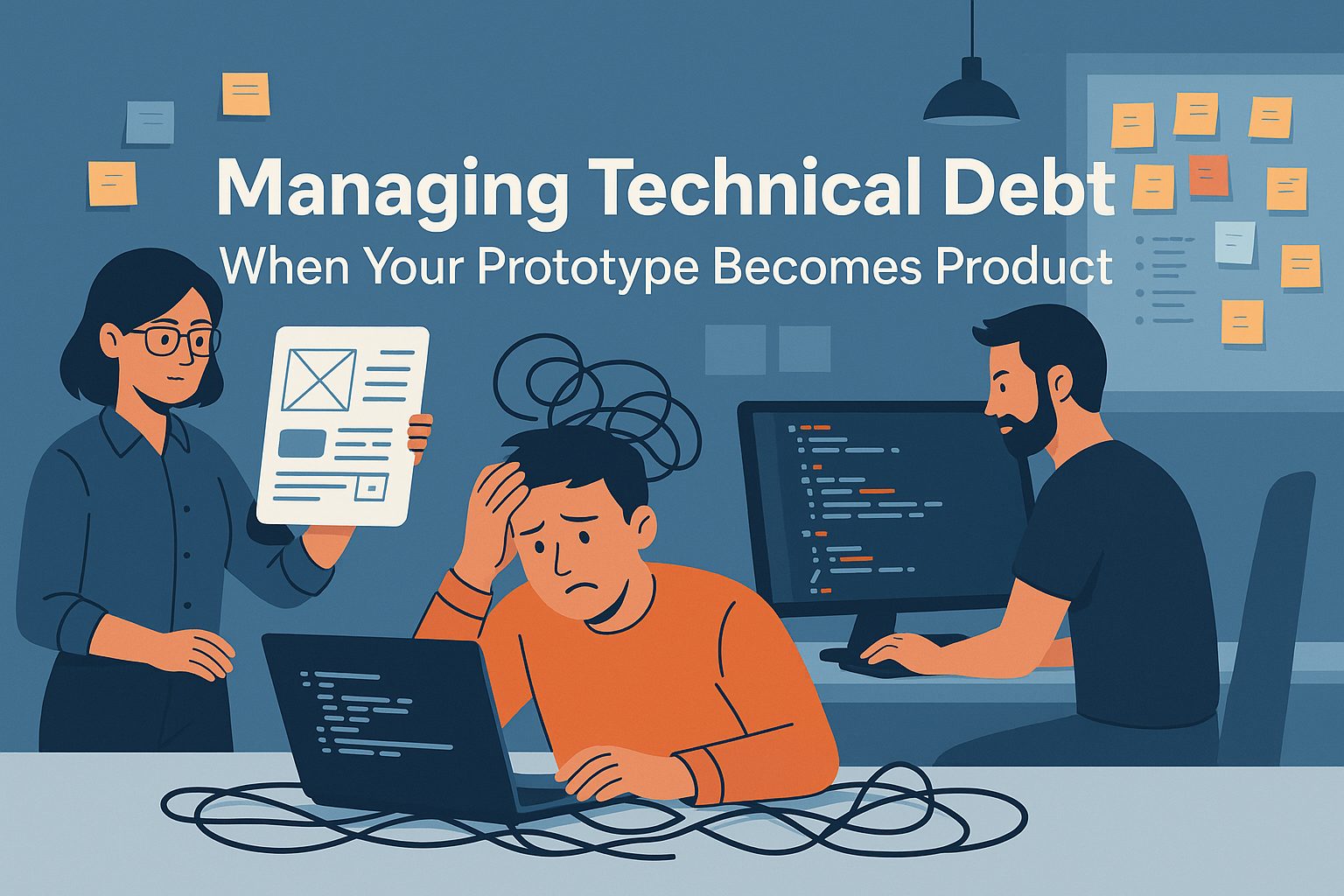
Prototypes are meant to be fast. They exist to validate ideas, test user flows, and help founders move from concept → reality. But when that prototype starts gaining traction, onboarding users, or receiving investor attention, something inevitable happens:
Your prototype becomes your product.
And your technical debt becomes your problem.
This post explains how to recognize technical debt early, how to manage it, and how to upgrade your prototype so it’s ready for production—without losing momentum.
Why Technical Debt Happens (and Why It’s Not Always Bad)
Technical debt is a natural byproduct of building fast.
It often comes from:
Quick decisions made for speed, not scalability
AI-generated code that lacks structure
Temporary hacks that stay longer than intended
Missing documentation and tests
One-off fixes that never get cleaned up
Features built before the architecture was ready
Not all debt is harmful. In early-stage prototyping, “intentional debt” lets you validate ideas faster.
The problem starts when this debt carries forward into the product stage.
The Moment You Feel Technical Debt
You know your prototype is turning into a product when:
Small features start taking longer than expected
Fixing one bug breaks something else
Your codebase feels “fragile”
New developers struggle to onboard
Performance drops under real traffic
You fear deployments
You say “we’ll fix it later” … too often
This is the pain of unmanaged technical debt.
Why Technical Debt Gets Dangerous
If left unresolved, technical debt leads to:
Slow development velocity
Frequent outages or regressions
Scaling bottlenecks
High infrastructure cost
Poor user experience
Inability to pivot or add features quickly
Higher long-term refactoring cost
Founders often don’t realize the real cost:
Debt compounds just like financial debt.
The longer you ignore it, the more expensive it gets.
How to Manage Technical Debt When Prototype Becomes Product
Do a Technical Debt Inventory
Before fixing anything, understand what you’re dealing with.
Look for:
Hard-coded values
Missing validations
Weak authentication/authorization
Spaghetti code or inconsistent patterns
Slow queries / poor schema design
Zero modularity
AI-generated fragments with no cohesion
A simple Notion table or GitHub issue list is enough.
Prioritize by Impact, Not Difficulty
Not all debt is equal.
Prioritize items that:
Block users
Block development
Risk data exposure
Cause performance problems
Create high costs in cloud infra
Use this rule:
If it slows the team weekly → fix it now.
If it slows the team monthly → schedule it.
Introduce Minimal Architecture (Not a Full Rewrite)
Founders often jump to:
“Let’s rewrite the whole thing.”
Don’t.
Instead, apply incremental architecture, such as:
Layered structure (API → Service → Repository)
Modular folders
Clear naming conventions
Shared utilities
Environment-based configs
Small structure changes create huge clarity.
Start Refactoring in Small, Continuous Steps
Refactoring works best when:
It’s part of weekly cycles
It happens alongside new features
Every PR leaves the code a little cleaner
The goal:
Refactor as you build, not after everything breaks.
Add Monitoring, Logging & Error Tracking
You can’t manage debt you can’t see.
Add:
API response logging
Error boundaries
Crash reporting (Sentry, Logtail, etc.)
Performance metrics
Health checks
CI/CD pipelines
Observability exposes debt long before users notice it.
Document Before Scaling the Team
Even minimal documentation helps.
Document:
How modules work
Key flows
API endpoints
Environment variables
Deployment process
Documentation pays off the moment you hire your second dev.
Use a “Debt Budget”
Allocate 10–20% of development time to paying down debt.
Example:
If you ship features 4 days a week,
use Friday as the cleanup & improvement day.
This keeps the codebase healthy without slowing the roadmap.
From Prototype → Product: The Mindset Shift
A prototype says:
“Make it work fast.”
A real product says:
“Make it work reliably.”
When you begin getting customers, traction, or revenue—your code needs:
Stability
Predictability
Security
Scalability
Maintainability
Technical debt doesn’t disappear,
but smart teams control it instead of letting it control them.
How VibeToLive Helps
If your prototype is evolving into a real product and the technical debt is piling up, VibeToLive helps you:
Audit your codebase
Identify hidden technical debt
Clean and refactor critical parts
Add structure, tests, and observability
Prepare the system for real-world traffic
Deploy with confidence
Move from Vibe → Live without breaking your momentum.
Conclusion
Technical debt is not a failure — it’s a phase.
But ignoring it is what hurts startups.
By identifying it early, organizing it, and gradually eliminating it as your prototype becomes product, you set your team up for long-term speed, confidence, and growth.
Ship fast — but clean as you go.