
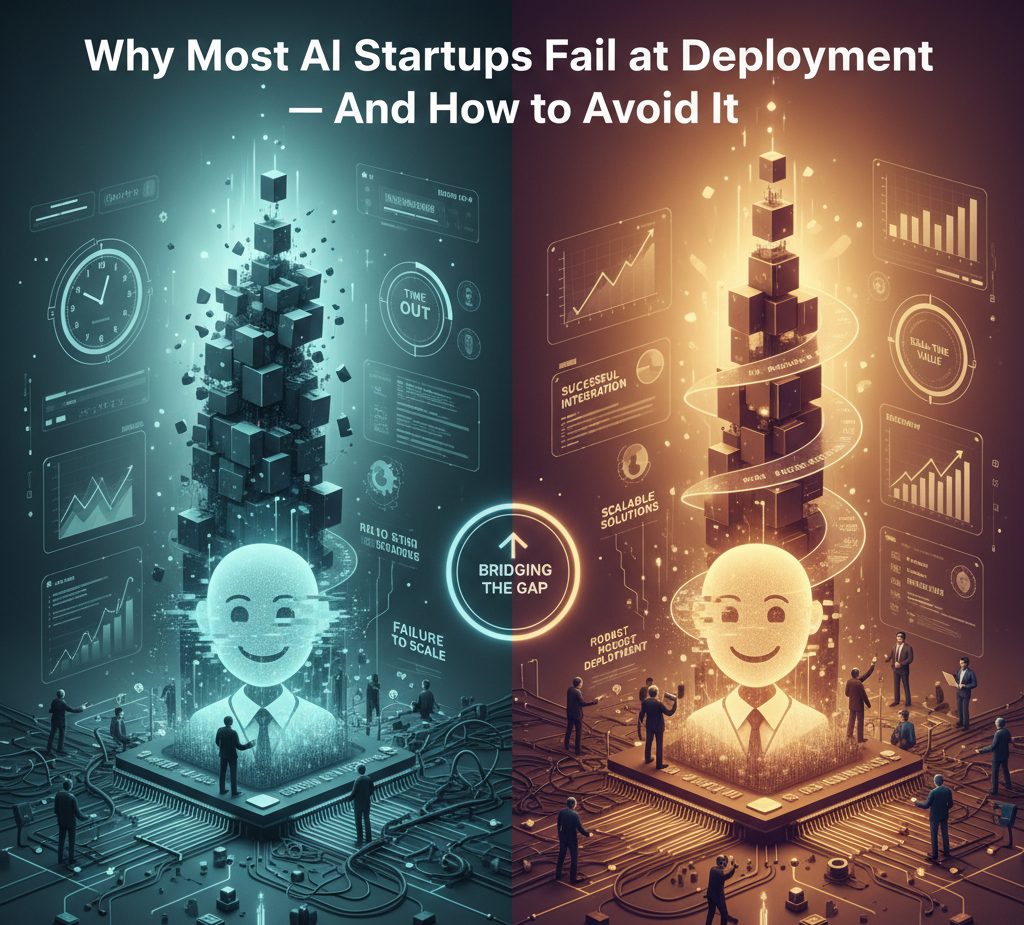
AI startups are booming. Every day, new founders launch prototypes powered by GPT, Stable Diffusion, or open-source models. Yet, according to industry data, over 70% of AI projects never make it to production.
The reason? Most teams can build a demo, but they can’t deploy it safely, reliably, or at scale.
At VibeToLive.dev, we’ve worked with dozens of early-stage AI startups — and we’ve seen the same avoidable mistakes repeated again and again.
Here’s why they fail, and how you can avoid the same fate.
No Production Mindset from Day One
Many startups focus on features, not foundations.
Their prototypes work - but only locally or in a test environment.
Once real users arrive, bugs, crashes, and scaling issues appear instantly.
Pro Tip:
Design your project architecture with production in mind - CI/CD pipelines, proper error logging, and scalable cloud services.
Our “Vibe → Live” system at VibeToLive.dev transforms messy prototypes into clean, deployable builds.
Ignoring Infrastructure and Cloud Costs
Founders often underestimate cloud expenses.
They deploy an AI model on a single GPU server, then panic when monthly bills spike.
Pro Tip:
Use autoscaling setups, serverless endpoints, or container-based solutions (like Kubernetes).
We help startups right-size their infrastructure - balancing cost and performance without compromising speed.
Security Neglect: The Silent Killer
One of the biggest reasons for AI deployment failure is security mismanagement.
Exposed API keys, unsecured storage, and poor access control can sink a project overnight.
Pro Tip:
Apply strong security hygiene: environment variables, encrypted secrets, and least-privilege access.
At VibeToLive.dev, every deployment includes a security readiness pass — ensuring your product can grow safely.
Lack of Monitoring and Observability
You can’t fix what you can’t see.
Startups often go live without proper metrics or alerts, leaving them blind to user behavior and performance issues.
Pro Tip:
Use tools like Prometheus, Grafana, or Datadog for full-stack visibility.
We integrate observability pipelines so you get instant insights into uptime, latency, and error rates.
Overlooking the Human Element
Technology isn’t the only challenge — team workflow and process matter too.
Without structured collaboration, deployment breaks down.
Pro Tip:
Document your environment, communicate changes clearly, and use version control effectively.
Our experts guide your team through DevOps best practices — making your workflow smoother and more sustainable.
How VibeToLive.dev Helps AI Startups Win
We specialize in bridging the “prototype-to-production” gap through:
Deployment engineering with CI/CD and auto-scaling
Security audits and DevSecOps setup
Cloud optimization for cost control
Monitoring & observability pipelines
Post-deployment support for updates and scaling
Each step is backed by real-world engineering experience, not just theory — that’s what EEAT means in practice:
Expertise: Experienced engineers who’ve shipped live AI systems.
Experience: Proven deployment cases from AI MVPs to production SaaS apps.
Authoritativeness: Recognized for helping startups go live safely.
Trustworthiness: Transparent, documented, and secure processes.
Conclusion
Building an AI app is easy.
Deploying one that survives real traffic — that’s the hard part.
Most AI startups fail not because of poor ideas, but because they skip the engineering that makes those ideas real.
That’s exactly what VibeToLive.dev was built for — helping you deploy smarter, scale faster, and grow with confidence.